

There’s one word doing all the heavy lifting behind every “rose name” list you’ll find online: 薔薇 (bara). It’s the actual Japanese word for rose, and almost nothing else on the internet about “Japanese rose names” holds up once you check the kanji against real naming records.
That’s not a knock on wanting a rose-themed name. Roses carry real weight in Japanese aesthetics — passion, elegance, a kind of beauty that comes with thorns attached. But most “500 Japanese names meaning rose” lists floating around are AI-generated kanji soup: characters strung together because they looked pretty, not because they form real names or even pronounce the way they’re claimed to. If you’re naming a child, a character, or a brand, you deserve to know which is which.
This guide gives you both: the real linguistic ground truth about rose in Japanese, and a set of clearly-labeled creative name ideas you can actually use for fiction, gaming, or branding — without mistaking them for traditional Japanese names.
The Real Word for Rose in Japanese
The standard word is 薔薇 (bara). It’s written with two kanji that are almost never used separately in modern Japanese — they exist as a linked pair, largely reserved for this one word. That’s actually the first sign something’s off in most “rose name” generators: they split 薔 and 薇 apart and bolt them onto other kanji as if they’re modular building blocks. In real Japanese, they mostly aren’t.
Because 薔薇 is visually complex, it’s frequently written in katakana instead: バラ. You’ll see this constantly in brand names, shop signs, and casual writing — it’s easier to read at a glance than the full kanji form.
There’s also an older, more poetic route to “rose” in Japanese naming: borrowing from words that evoke rose-like qualities rather than naming the flower directly. Think 紅 (kurenai, deep crimson), 香 (kaori, fragrance), or 麗 (rei, beautiful/elegant) — kanji genuinely used in real Japanese given names, often to suggest the sensory experience of a rose without spelling out the flower itself.
Why 薔薇 Rarely Appears in Real Japanese Given Names
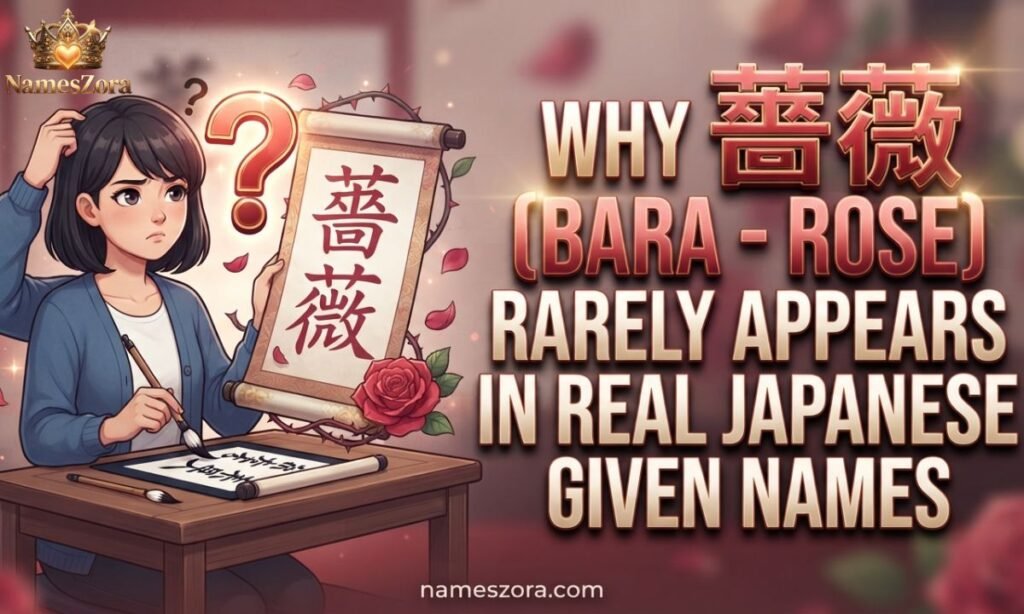
Here’s the part most rose-name articles skip: 薔薇 is almost never used in actual Japanese first names. Japanese naming conventions favor kanji that are simple to write, have auspicious meanings, and read clearly at a glance for a lifetime of paperwork. 薔薇’s two kanji are among the most complex in common use — 17 and 16 strokes — which makes them impractical for a name a person will write thousands of times.
Parents wanting floral names in Japan reach for kanji that carry similar meaning with far less complexity: 花 (hana, flower), 咲 (saki, to bloom), 華 (hana/ka, splendor/flower). These show up constantly in real names — Hanako, Sakura, Hanae — because they’re both meaningful and practical.
So when a list claims dozens of “traditional” names built from 薔, it’s worth being skeptical. That doesn’t mean rose-inspired names are off the table. It means the honest path runs through floral and beauty vocabulary, not through forcing 薔 into combinations that don’t reflect how the language is actually used.
Real Japanese Names That Genuinely Connect to Rose Symbolism
These aren’t built from 薔 — they’re existing Japanese names that carry rose-adjacent meaning through flower, fragrance, or crimson-color kanji, the way real parents actually name children in Japan.
| Name | Kanji | Meaning |
| Hana | 花 | Flower |
| Sakura | 桜 | Cherry blossom, often used more broadly for floral beauty |
| Kaori | 香 | Fragrance |
| Kurenai | 紅 | Deep crimson, the color most associated with red roses |
| Reika | 麗花 | Beautiful flower |
| Kaoru | 薫 | To be fragrant |
| Beni | 紅 | Crimson red |
| Hanae | 花恵 | Blessed with flowers |
If you want a name that’s genuinely rooted in Japanese naming practice and still gestures toward what a rose represents, this is the honest list. Short, real, and verifiable.
Creative Names for Boys (Fantasy/Character Use)

These combine 薔 (bara) with other kanji in ways that read as stylized rather than traditional — good for fiction, games, or original characters, not for claiming as authentic historical names.
- Baraki (薔木) — invented compound reading as “rose tree”
- Renba (蓮薔) — pairs 蓮 (lotus) with rose imagery
- Shunba (俊薔) — talent/rose combination, stylized
- Ryuba (龍薔) — dragon and rose paired for a bold sound
- Kenba (剣薔) — sword and rose, common in character naming for a “beauty with an edge” archetype
Creative Names for Girls (Fantasy/Character Use)
- Barako (薔子) — “ko” is a genuine, common name suffix, giving this one a more natural feel
- Hanabara (花薔) — flower plus rose, doubling down on floral imagery
- Himebara (姫薔) — princess rose, popular in character naming for regal characters
- Yumebara (夢薔) — dream rose, soft and lyrical
- Sakubara (咲薔) — blooming rose
Creative Unisex Names
- Harubara (春薔) — spring rose
- Aibara (愛薔) — love rose
- Shinbara (真薔) — true rose
- Kiyobara (清薔) — pure rose
- Terubara (輝薔) — shining rose
Creative Surnames (For Fiction and World-Building)
Japanese surnames often reference geography — mountains, rivers, fields — which makes rose-surname combinations feel plausible even when invented.
- Barayama (薔山) — rose mountain
- Kawabara (川薔) — river of roses
- Barazono (薔園) — rose garden, arguably the most natural-sounding of the set
- Moribara (森薔) — forest of roses
- Baratani (薔谷) — rose valley
Fantasy-Leaning Names for World-Building

For settings that blend Japanese aesthetics with invented mythology, these lean harder into stylization and sound less tied to real-world Japanese phonetics — useful for games, anime-style fiction, or fantasy branding.
- Baranova — noble rose
- Lunabara — moonlit rose
- Elaribara — glimmering rose
- Shinaria — divine rose realm
- Kibarastra — rose starlight
How to Tell a Real Japanese Name From an Invented One
You don’t need to read Japanese to sanity-check a name before you use it. Three quick filters help:
Check if it appears in a real names database. Sites that document actual Japanese given names (not AI-generated lists) will show usage frequency and real kanji variants. If a name only shows up in “meaning” listicles, treat it as invented.
Look at stroke complexity. Real Japanese parents overwhelmingly favor kanji under 12 strokes for names. If every name in a list uses 薔 (17 strokes) or 薇 (16 strokes), that’s a strong signal the list wasn’t built from real naming data.
Ask whether the pronunciation matches the kanji. Japanese kanji readings aren’t arbitrary — each character has a fixed set of possible readings (on’yomi and kun’yomi). A name where the romanized pronunciation doesn’t correspond to any real reading of the kanji shown is a fabricated entry, full stop.
None of this means invented names are useless. Fiction, games, and branding invent names constantly — Japanese included. The problem is only when invented names get presented as historically real, which misleads people making a genuinely important decision, like naming a child.
Frequently Asked Questions
What is the actual Japanese word for rose?
The word is 薔薇 (bara), often written in katakana as バラ for readability in everyday use.
Is 薔薇 commonly used in real Japanese given names?
Rarely. Its kanji are too complex for everyday names, so parents typically choose simpler floral kanji like 花 or 咲 instead.
Are the “500+ rose name” lists online accurate?
Most are AI-generated and combine kanji in ways that don’t reflect real Japanese naming conventions or correct pronunciation.
What’s a real Japanese name connected to rose symbolism?
Kurenai (紅, crimson) and Kaori (香, fragrance) are genuine names tied to what roses represent, without needing invented kanji.
Can I still use invented rose names for a character or story?
Yes. Invented names work fine for fiction, games, or branding, as long as they’re not presented as authentic historical Japanese names.
Why do so many invented names use the same kanji pattern?
AI-generated lists often reuse 薔 or 薇 as a template piece, bolting it onto random kanji rather than following real naming logic.
Conclusion
Rose carries real meaning in Japanese, it’s just carried by different words than most “name generator” lists claim. 薔薇 (bara) is the genuine term, real names like Kaori and Kurenai capture its spirit through fragrance and color, and anything built by mashing 薔 onto random kanji belongs in the fiction pile, not the “traditional Japanese name” pile.
Use the real names if you want authenticity. Use the invented ones freely for characters and creative projects, just don’t confuse the two when the stakes are a person’s actual name.

With years of experience creating name-focused web content, NameZora brings together creative, unique, and trending name ideas in one easy-to-explore place. We focus on useful, SEO-friendly, and engaging content that helps you find the perfect name for teams, groups, gamers, businesses, characters, and more. Our goal is simple: make naming easier, faster, and a lot more fun.